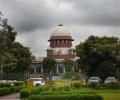
The Supreme Court has stayed the execution of an alleged Indian Mujahideen operative sentenced to death in connection with the 2013 Dilsukhnagar blasts.

Speaking to ANI on Tuesday, Rakesh Kishore said that he was hurt by the CJI's remarks while dismissing a plea seeking restoration of the structure of Lord Vishnu in the Javari temple in Khajuraho.
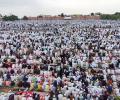
'We are not all Abduls, you know. Our community has any number of retired civil and defence officers, doctors, engineers, lawyers.'
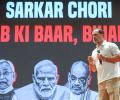
'Rahul Gandhi's problem is that he doesn't think big.' 'He looks more like an activist, while politics is like a game of chess. You attack and then defend and have a game-plan.'
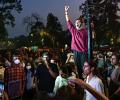
'It is high time to recognise that this is the greatest issue India is confronting.' 'Even the BJP should be raising concerns because polluted air suffocates everybody's child.'

The hope is that the film raises significant issues about the rights of women, and does not become a diatribe against a minority community that has happened with some recent films, points out Deepa Gahlot.
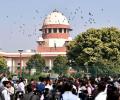
'A rigid or overly broad interpretation could lead to a chilling effect on investments and growth in sectors traditionally driven by private initiative.' 'Entrepreneurs may fear that their assets could be arbitrarily appropriated by the State under the guise of serving the 'common good' without sufficient legal safeguards.' 'The judgment thus supports a more nuanced view, one that balances individual property rights with public welfare objectives.'

Referring to the fatal incident that has so far claimed 41 lives, head of the panel and Bharatiya Janata Party MP, Hema Malini said that political rallies should be properly organised and conducted with full security.

The move comes barely two days after the authorities lifted the restrictions in Leh, 22 days after they were first imposed following violent clashes during protests demanding statehood and Sixth Schedule Status that left four persons dead and 90 injured on September 24.
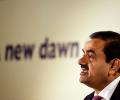
In a big boost to tycoon Gautam Adani, markets regulator Sebi on Thursday cleared the billionaire and his group of stock manipulation allegations made by US short-seller Hindenburg Research, saying fund transfer between group companies did not fall foul of any regulation.
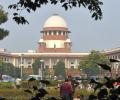
The Supreme Court is hearing arguments regarding a presidential reference on whether fixed timelines can be imposed on governors and the president for acting on bills passed by state legislatures. The court is considering objections to the maintainability of the reference under Article 143 of the Constitution.
A five-judge Constitution bench of the Supreme Court is scheduled to consider the Presidential reference on whether timelines could be imposed by judicial orders for the exercise of discretion by the President while dealing with bills passed by state assemblies.

New Zealand vs Pakistan women's WC game abandoned due to rain, SA qualify for semis

During the presser, Gandhi showed a picture of a woman who appears on the voter list 22 times in 10 booths in the Rai assembly constituency, and said this shows that this was a 'centralised operation'.

Made at a time when an insidious agenda can be read into it, Haq is an important film that deals with a contentious subject with maturity, observes Deepa Gahlot.
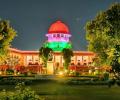
The Centre has told the Supreme Court that imposing fixed timelines on governors and the president to act on bills passed by a state Assembly would amount to one organ of the government assuming powers not vested in it by the Constitution and lead to a "constitutional disorder".

AIIMS-Delhi reports a rise in eye injuries caused by carbide guns during Diwali, prompting calls for a ban on these dangerous chemical firecrackers. Doctors report severe chemical burn-like injuries and highlight the need for stricter regulations and awareness.

Alexandre Padilha's daughter and her mother were stripped of their US visas because the Trump administration is incensed that Brazil's current government pursued Trump ally and Brazil's ex-president Jair Bolsonaro to face justice for his role in a 2022 coup attempt.

A profile of B Sudershan Reddy, former Supreme Court judge and Opposition's vice presidential candidate, highlighting his career, judgments, and contributions to constitutional law.
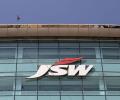
The Supreme Court on Friday declared JSW Steel Limited's resolution plan for Bhushan Power & Steel Limited (BPSL) "illegal" and ordered the latter's liquidation, four years after the company was acquired by JSW Steel under the Insolvency and Bankruptcy Code (IBC). Following the ruling, JSW Steel shares fell sharply.
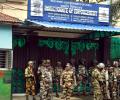
The Supreme Court of India has repeatedly criticized the Enforcement Directorate (ED) for exceeding its authority and misusing its powers. The latest rebuke came on Thursday, when the court accused the agency of 'crossing all limits' in a money laundering probe against a Tamil Nadu state-run liquor retailer. This follows a string of similar observations by the Supreme Court and high courts across India, raising concerns about the ED's investigative practices and the potential for misuse of its powers.
The Supreme Court has scheduled hearings starting August 19 for the Presidential Reference concerning constitutional issues related to timelines for handling bills passed by state assemblies. The court has directed the Centre and states to submit written arguments by August 12.

The Centre has opposed the imposition of fixed timelines on governors and the President for decisions on bills passed by state legislatures, arguing that such constraints were intentionally omitted by the Constitution's framers.

Buildings were decorated with colourful lights and earthen lamps dotted houses as people across the country thronged temples and celebrated Diwali with pomp on Monday.

The 2025 Redefined Thar takes that phenomenal, rugged capability and wraps it in a shell of genuine usability. Rajesh Karkera/Rediff simply cannot stop raving about the offroad civilised beast.

A look at the legal provisions governing the removal of the Chief Election Commissioner (CEC) and Election Commissioners (ECs) in India, amid threats from opposition parties.

'The moment they fall foul of the party in power, they become unsafe. Then nobody can guarantee their safety.'

Vantara will join the Maharashtra government's petition in the Supreme Court to seek the return of elephant Madhuri to a monastery in Kolhapur, Chief Minister Devendra Fadnavis said.

The home ministry said the central government would continue to welcome the discussion with LAB and KDA through the high powered committee on Ladakh or any such platform.
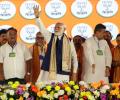
BJP strategists are missing something somewhere, and they have not acknowledged it, to be able to repair it in good time, points out N Sathiya Moorthy.
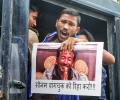
The Supreme Court has sought responses from the Centre and the Ladakh administration regarding the detention of climate activist Sonam Wangchuk under the National Security Act (NSA). Wangchuk's wife has filed a plea challenging the detention, claiming it violates his fundamental rights. The court has given the Centre and Ladakh administration 10 days to respond and has scheduled the next hearing for November 24.

On November 18, 1962, 114 soldiers of the 13th Kumaon fought till the last man, and last bullet, in sub-zero temperatures, to beat back the huge Chinese army. We salute the Heroes of Rezang La.
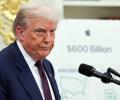
As one of the federal appeal courts in the United States ruled that most of tariffs imposed by Trump administration are not accordance with the laws, US President Donald Trump on Friday (local time) affirmed that all tariffs imposed on the countries will remain in effect, calling a recent ruling by a 'highly Partisan Appeals Court' incorrect.

The Supreme Court is scheduled to pronounce interim orders on key issues related to the Waqf (Amendment) Act, 2025, including the power to denotify waqf properties.
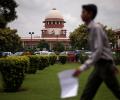
The Supreme Court is scheduled to pronounce interim orders on key issues related to the Waqf (Amendment) Act, 2025, including the power to denotify properties declared as waqf.

The Supreme Court acknowledged a clean chit from a special investigation team (SIT) regarding the Vantara zoological rescue and rehabilitation centre in Gujarat's Jamnagar, following allegations of irregularities.

'When maximum voter participation occurs, they do not vote to re-elect the incumbent government. They vote to change it.' 'How can anyone credibly suggest that crores of young voters -- particularly the unemployed youth -- would vote to re-elect an existing government that has demonstrably failed them?'

Adani Green Energy, the renewable arm of billionaire Gautam Adani's conglomerate, has withdrawn from two proposed wind power projects in Sri Lanka, following the Island nation's new government deciding to renegotiate tariffs. "Adani Green Energy has conveyed its Board's decision to respectfully withdraw from further engagement in the renewable energy (RE) wind energy project and two transmission projects in Sri Lanka," the firm said in a statement.
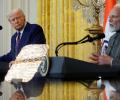
The Trump administration has told the US Supreme Court that it imposed tariffs against India for purchasing Russian energy products as part of its strategy to address the war in Ukraine.

The Supreme Court has allowed certified manufacturers to produce green crackers, but restricted their sale in Delhi-NCR without approval. The court has asked the Centre to review the ban on firecracker manufacturing in the region.
